Beyond 1:1 remote operation case
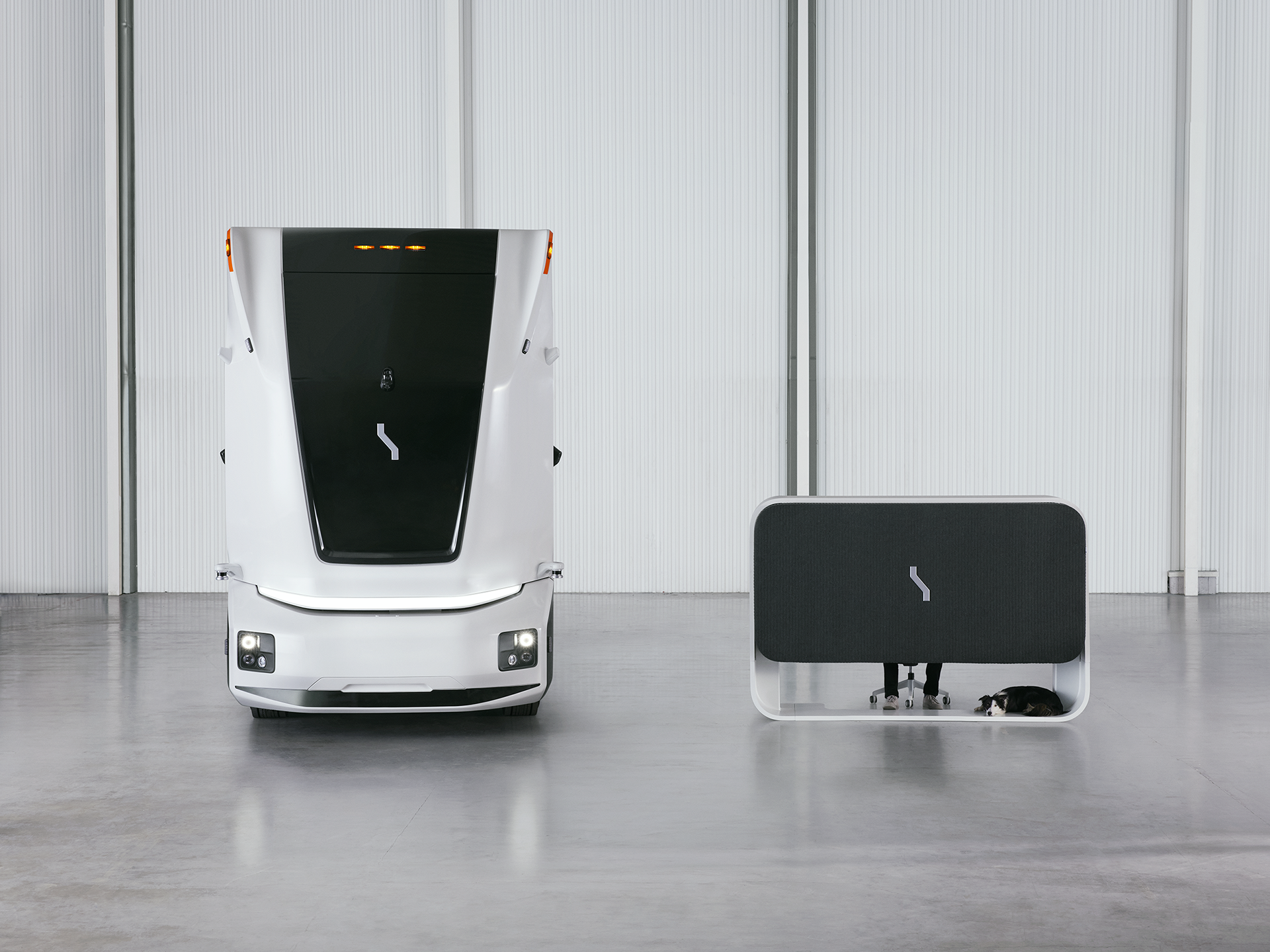
Photo by Einride
My Role at Einride
Product Designer
Timeline: 1 Year
Core Skills: Product Strategy, UX Research, Contextual Inquiry, HCI, Concept Design, Usability Testing, Stakeholder Management
Summary
What started as a theoretical exploration for my master's thesis quickly became a real-world product challenge. After presenting my research on the Remote Operators UX that would allow autonomous operations to scale, I was brought on full-time as a product designer to help turn theory into reality.
In this role i worked closely with both the Product owner and lead UX designer. I led foundational research, including stakeholder interviews and in-depth user studies, to finalise the project's scope. I was subsequently appointed as Discovery lead, where I used these insights to steer a cross-functional team through concept and prototype development, resulting in a validated concept that was handed off to be further developed into the final deliverable product.
Remote operation
In short, Remote operation is when a human Remote Operator (RO) user oversees an Autonomous Vehicle (AV) remotely. This allows for AVs to be designed without a cab while still being bale to rely on support from a human. The RO uses an product at Einride called the Control tower to perform Remote operation tasks on the AV. This product incorporate both the hardware, such as controls, screens and working area, as well as the software and UI. The UI allows the RO to receive information and data from the AV. The Control tower makes it possible for the RO to manage and assist AVs that operates in both Autonomous and Remote Drive mode.

The Challenge: Moving from 1:1 to 1:N
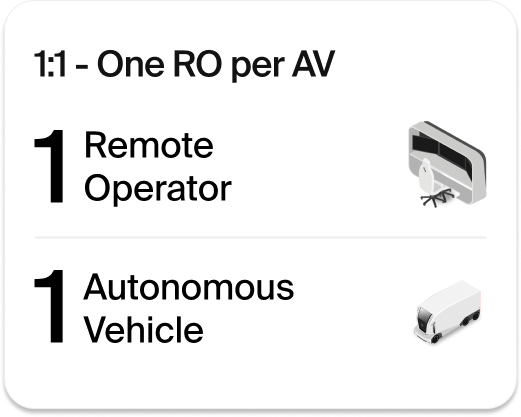
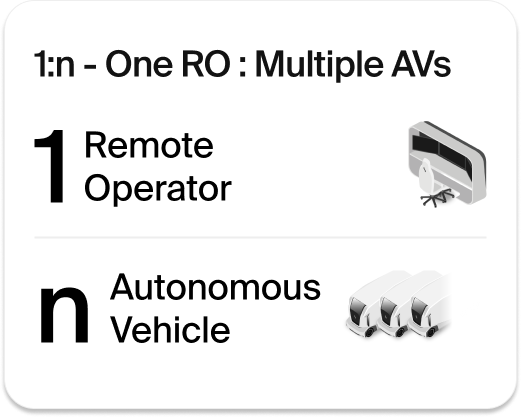
The existing platform for managing autonomous assets was built on a 1:1 model, where one expert operator was required for each active asset. This model created a significant operational bottleneck (high OPEX) and limited scalability.
The Goal: To research and design a user-centric and safety-critical 1:N (one-to-many) UI for the Control tower product. That could be implemented in a short time-span and without major overhaul to the current backend or Autonomous systems.
My Role: Bridging Product Strategy and UX Design
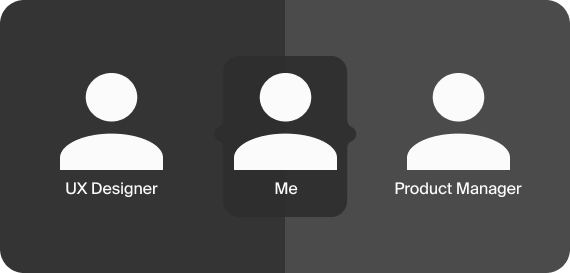
As a Product designer, I functioned as a true hybrid, working closely with my Senior Product Manager on strategy while embedding with the Lead UX Designer as a UX Designer/Strategist (co-designing concepts, mapping user journeys, and leading validation). This gave me a unique position to work cross-functionally and act as a support for both parties.
A key part of my role was to navigate this complex problem space by aligning a wide range of stakeholders, including expert users (the Remote Operators), operations managers, and the autonomous systems engineering leads.
Key Challenges & Learnings
Challenge 1: Designing for an Unprecedented Workflow
We were defining a new operational model for the company, not just improving a feature. This ambiguity meant there was no playbook.
We were defining a new operational model for the company, not just improving a feature. This ambiguity meant there was no playbook.
I learned to create clarity by working in an iterative loop of discussion and co-creation with the Users, Product Manager, UX designer, and other vital stakeholders.
Challenge 2: Shifting towards a new generation
The current system was mainly designed with 1:1 in mind. Resulting in many workarounds and temporary fixes to allow for 1:n operations. A new platform and approach was needed to allow for a optimal user experience working with a fleet of vehicles rather then singular vehicles. Additionally since the need for the new platform was urgent the project had to be able to be lightweight from a development perspective and be deployed without interfering with or major changes to the current UI.
Challenge 3: The "Expert User" Imagination Gap
While performing user research through interviews we realise only highlighted current issues the user had, they struggled to envision future needs. When asked to envision the future we learned that the most effective way to get actionable feedback was to present operators with tangible, interactive concepts that simulated their future tasks.
Because this was a completely novel workflow that no one had experienced, users understandably had difficulty visualizing it without a concrete prototype.
This "Research-through-design" approach allowed us to get highly specific feedback and helped operators articulate complex needs they hadn't yet considered.
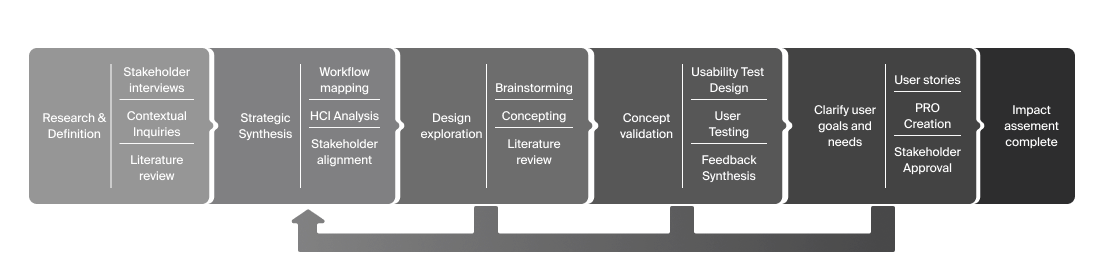
My Biggest Takeaway: Insight is Forged, Not Found
On this project, there was no single "Aha!" moment. The solution was forged through a collaborative process of refinement. My key learning was that for highly complex problems, the path to clarity is to rework, question, and iterate, even if it means taking a few steps back. This loop was the engine that turned ambiguity into a clear, validated concept.
Solution & Demonstrable Impact
While the final designs are confidential and in development, final designs or sketches cannot be disclosed. However, there are three main takeaways for my contribution on this project:
1. Unlocked the "Discovery Phase"
My research and insights were key to shaping the user stories that clearly defined what the system had to deliver. The iterative process allowed for user stories to be created and then validated using a concept prototype. Which in turn grounded our concepts by the end users' feedback. These grounded concepts aided the Product Manager in finalising the proposed user stores.
– The initial concept I helped design and test was used to validate our core theories about a new, more scalable operational model.
– Gather insights and presented findings that led to the finalisation of the impact assessment report
– Presented final impact assessment for approval to move forward into the discovery phase
2. Discovery lead
During the Discovery phase, I was chosen to be the Discovery lead, meaning i was in charge of driving the project through the discovery phase and making sure stakeholders were involved and aligned with each other. This included design, development, end users and the Product Manager. I was also heavily involved in the design work, working closely with the Senior UX designer in creating the new concepts that were then evaluated by user tests I designed and hosted.
– Led the discovery process
– Designed a new iteration of the prototype
– Planned and led the expert user test to validate the prototype
– Worked cross-team with multiple stakeholders to validate the final findings in the discovery report